I’ve recently bought a painting. I’m not rich enough to be a serious collector, but this was a bit special. Let me explain. When I worked at Wakefield College in the eighties, I took a flat in Heath Hall, a Georgian stately home in a village just outside Wakefield. I’ll tell you how stately: my lease required access twice a year to the monumental clock that dominated the hall’s stable yard. Just over the village green was The Old Smithy and Joiner’s Shop, a renovated cottage which was the home of Gyorgy and Marian Gordon, two Hungarians who came to the UK after the 1956 uprising. Gyorgy was an artist, and after working for a while in commercial graphic design, he was offered a job lecturing at the college in fine art. He worked with many distinguished students, but after some years made the decision to retire to work full-time as a painter. His work is in several major galleries, here and in Hungary. The portrait of the Lindsey String Quartet in the National Portrait Gallery is his, and the Hepworth Gallery as well as the NPG has hosted an exhibition of his work.
Gyorgy died in 2005, and the Lindseys played Bartok – what else ? – at his funeral. There are several good obituaries. The Independent one reads well, as does the Wakefield Art Gallery. They describe an extraordinary life, one that reminds those of my generation, born in Britain at the end of the Second World War, what a charmed time we have led. Gyorgy grew up in wartime Hungary, was conscripted as a teenager to serve the German economy as a forestry labourer. When the word came that they were going to be drafted into the army to fight the Russians, he escaped to the chaos of occupied Budapest. He told me once of seeing the tanks of the Red Army enter the city whilst hiding in the damaged flat of family friends. That period affected his art – the torso of a horse killed for meat in a frozen street shown in one of his more harrowing works. After the war, he studied in an increasingly Communist country, until the events of 1956 led him to flee to the west, over the passes to Austria, hand-in-hand with his daughter. His first wife, a dedicated Communist, stayed.
Despite these events, he was a lovely man, cultured, kind, witty. My children remember him with affection. I spent some memorable evenings at the Heath house, once playing bridge in Hungarian with a visitor from the homeland. When the Berlin Wall fell, the Hungarian government could acknowledge the quality of his work, and I was able to visit an exhibition in Budapest itself. I liked the style of his work – very central European, with a bleak expressionism, apparently at odds with his charm and generosity.
For all of these reasons, I’d long wanted to own one of his paintings, and there are sites on the web that alert you when particular artist’s work comes up for auction. To cut a long story short, I saw that one was going to be sold in an auction at Ilkley, made a bid by e-mail, and won for the ludicrous sum of £500. VAT, framing and auction costs doubled that, of course, but … no regrets.
There are some wonderful clips and films on YouTube. You can sit at breakfast, or on your exercise bike, and look at lectures on the War of Austrian Succession, explanations of the workings of a two-stroke engine and concerts by wonderful musicians, classic or popular, that you’ve heard of or not. You can also find fascinating but weird memes. One guy films himself cleaning out and reshoeing the feet of cows and horses, and it’s fascinating. There’s an American doctor squeezing and cutting out pimples and cysts from a variety of patients/victims. Even effective and victorious England cricket teams.
But there’s one group in which genuine historical information and access to wonderful cinema clips from the 1920s and 30s are broadcast: not drama, just newsreels from world cities or publicity flicks from transport companies or public corporations, Victorians cross London’s bridges, with their universal hat-wear. Horse-drawn buses swing and sway along recognisable urban thoroughfares. Spotless suburbs attract the 1940s home buyer away from the congested inner city. I used to like these, but sadly, the infection from Twitter has spread across to YouTube, and the comments appended to these clips are usually right-wing dross – racism dressed up as nostalgia for a purer, better age. Perhaps I’m getting paranoid, but I think the sub-text to the various versions of “London looks like a wonderful city – I wonder what became of it” can be filed among the nasty stuff attacking the current mayor (who has an Asian background) as presiding over a unmanageable and murderous cityscape, and the (wildly incorrect, funny if it wasn’t so nasty) American right wing idea that British cities are crime-ridden hell-holes.
I used to do sombre corrections, pointing out that the crime rates in UK cities are way below those in the USA. As someone who lived in London in the 1950s, I’m immune to much nostalgic nonsense. I walked to school in the smog. I met young people limping after polio, their braces clanking. I remember a time before the “health and safety nonsense”, when 30 people were killed at the 1952 Farnborough Air Show and 90 more from the 1957 Lewisham rail crash. You only have to look at black-and-white working class dramas of the period on TV – on Talking Pictures TV, for example – to see its drudgery and poverty. I’ve realised, though, that aggressive counter-punching contributes to the pollution of the channel, and have chosen wide-eyed and innocent helpfulness instead. I append below my response to the latest “what happened to London ?” comment,
“Good news, I’m glad to say. Life expectancy rose considerably. Household income more than trebled. Central heating, Multichannel TV. Washing machines, Greatly increased car ownership, with falling road deaths. Crime rates fell. Foreign holidays. Internet. Effective and accessible contraception. A new National Theatre and buzzy South Bank. Free, magnificently modernised museums. Smog, which killed 12,000 in 1952, eliminated by Clean Air Acts. Much better food, from all over the world. 3 new tube lines, plus the DLR to support regenerated Docklands. Blackwall Tunnel doubled in capacity, plus the M25 and Dartford Crossing. An end to compulsory military service, and colonial wars. University entry rises from 4% to 45%. Free health care. London’s schools radically improved. Filthy public buildings cleaned, to face new and innovative towers – the Shard, the Gherkin and many others. Painless dental care. Drinkable beer and edible bread. 29 Olympic Gold medals at London 2012, against 3 in the 1948 London Olympics. Gay people live without fear, and backstreet abortions have gone. I could go on …”
I have currently had no reply. Of course I haven’t.
I thought I was the only person in the world who didn’t like the amount of muzak/music being played in non-musical places at the moment, until a meal with friends on holiday – where I timorously asked the waiter if the music could be turned down – was met with looks of relief and support. Why do owners of restaurants want to drown us with pseudo-disco music, or someone wailing about their amorous angst ? Do they think customers prefer to listen to 1980s dross – or 2020s dross – rather than talk to each other ? I asked the web, and was told that people eat quicker and drink more if there is music playing. In my case, that’s right because I eat faster, and avoid the dessert, in order to get out of the place. I’ve actually been in restaurants where my wife and I were the only customers, and found resistance to turning the music down – which caused me to walk out of a restaurant in Sicily.
Even the good old Ivy Restaurant plays music (subtly, but … why ?). And it’s not just bars and restaurants. A phone enquiry to an energy or insurance company will play crap music whilst you’re waiting for your enquiry to be answered (“due to a high volume of calls”): the otherwise excellent Octopus Energy tells me “while you’re waiting, here’s a track I hope you’ll like”. Tuneless guitar thumping ? Er, no, I bloody didn’t.. A car pulling up next to you at traffic lights will bombard you through an open window with the latest R&B – it’ll never, I guarantee, be a Bartok String Quartet[1]. Shopping centres generally give us music as we browse – indeed, some French towns pump pop music through tinny speakers in their entire shopping areas. Yes, Pontivy, it’s you I’m talking about.
There are signs, a few hopeful signs, that we’re reaching peak music blasting. A letter in the Observer last week complained of the practice, and I read in the press that there may be a move to prevent train and bus travellers imposing their tastes on fellow passengers (which I thought was an urban legend, but happened to a family member last week on quite a long journey). If so, hurrah. There could also be could be a citizens’ response, a sort of neighbourhood watch of the airwaves. A while ago I pulled up in a shopping centre car park in Sheffield, near a car where all the doors were open and bad pop music was being blasted to fellow shoppers. I opened my door and retaliated with a loud Purcell Fantazia. There were looks of astonishment, and then a shrug of “OK, you got me there” as their volume lessened and doors shut.
I like music, and have pretty catholic tastes, but I don’t insist on imposing it on other people. When did this all start ? Is it just that, it’s technically possible: we can do it so we will do it ? If so, I have news for all the undesired broadcasters. We have earphones now, don’t we ?
[1] One exception. The first time I entered the Fat Cat pub in Sheffield’s Kelham Island, there was Mozart being softly played. This was years ago, which I know because it was the first no smoking pub I had been to.
I recently found myself – much against my better judgement – engaged on Twitter/X with a climate change denier. The difficulty facing the deniers is that 99% of scientists in this field believe that human engendered climate change is happening, and constitutes a danger to life on the planet. Their rebuttal of this is that all these scientists (and NASA, and the Royal Society, etc etc) have been bribed by government because government wants to boost its spending, and climate change provides an excuse to increase taxation.
This is, of course, ludicrous. If there is slush money to change what scientists say, it is more likely to come from oil companies than university research grants. Anyone who knows about higher education knows that reputations are made, not by going with the flow but by disproving current wisdom and commonly held beliefs. In any case, climate change action doesn’t increase government revenues – there is no climate tax that passes to the hands of megalomaniac politicians and civil servants. But there’s a more forceful reason to know it’s nonsense. Anyone observing the politics of Europe in the last ten years or more – since COVID, since the 2008 financial crash – will know that governments are desperate to reduce public deficits, and to avoid increasing taxation. There is concern inside and outside government about the cost of borrowing or the size of the National Debt. Nothing would delight governments more than the discovery that climate isn’t changing, and that fossil fuels are not involved.
Which comes to my point. The climate denial mob are not alone.
Those who believe in the Laffer curve tell the government that, if they cut taxation, there would be a rise in government tax receipts as incentives lead people to work harder, increase their incomes and thus boost the economy. We’ve even heard it recently from Richard Tice of the Reform Party, with the usual nodding interviewer alongside. “The Times” even published budget advice by Laffer himself, the man who is to fiscal prudence what Uri Geller is to metallurgy. But it’s just not true – as I (and many others) have demonstrated elsewhere. Where it’s been tried, it’s been a disaster. But, for a moment, let us suppose that it is true. What they are saying is that governments are keeping taxes and budget deficits higher than they need to be, which leads to the question – why on earth would any government do that ?
On the left, there are enthusiasts of Modern Monetary Theory (MMT) which maintain “that the level of taxation relative to government spending (the government’s deficit spending or budget surplus) is in reality a policy tool that regulates inflation and unemployment, and not a means of funding the government’s activities by itself. MMT states that the government is the monopoly issuer of the currency and therefore must spend currency into existence before any tax revenue could be collected.[1] The government spends currency into existence and taxpayers use that currency to pay their obligations to the state.[2] This means that taxes cannot fund public spending,[3] as the government cannot collect money back in taxes until after it is already in circulation. In this currency system, the government is never constrained in its ability to pay,[3] rather the limits are the real resources available for purchase in the currency.[3] “ (Wikipedia). So the government doesn’t need to raise taxes to support desirable programmes (unless we are at full employment)*. Again, why wouldn’t the government adopt this policy if it were true ?
Further left, we are told that government will not need to raise taxes if the unpaid debts of tax dodgers and the corporate sector can be hunted down. Of course there are dodgers, and the rich get away with too much in financial jiggery-pokery, and this needs to be chased with vigour. However, the sum involved are unlikely to be sufficient to be transformative. For example, unbiassed estimates suggest changing rules for multinationals will increase UK receipts by less than 1%. And again, let’s ask – if this were true, why wouldn’t governments do it ?
My climate change denier also claims that governments wish to bring in “millions of migrants to live on benefits”. It’s a policy would increase public spending and taxes and lose votes by the bucketful. So, again, why would any government want to do this ? (Yes, I have heard of the Great Replacement Theory, but that’s a whole new swivel-eyed anti-Semitic level of “why would governments ever want to do that”)
It’s OK to say governments are adopting the wrong policies, I think (even if Trump doesn’t). But the idea that governments throughout the advanced world are consciously adopting policies that make themselves look bad, and lose them elections when cheaper and more popular policies are available seems, well, as I said in my Twitter spat, silly.
In passing, those advocating this have been quieter since Liz Truss’s budgetary experiments.
This is a different kind of blog from me – no economics, no education policy, none of the wise stuff that has kept the site going for 25 years. It’s a travelogue, but a very special travelogue. I have a grandson who is a history enthusiast and I’ve long promised him that we’ll do a tour of World War 1 battlefields. He’s off to university in a few weeks, so it was now or never.
The outline What we planned was a visit to the two main sites of action for British and Empire forces between 1914 and 1918. One was Flanders, with the Ypres Salient and Passchendaele at the centre of the fighting. The other was, inevitably, the Somme, with the ghastly fighting of July 1916 just one episode in a long and bloody encounter. I say “Empire” because that was the term then used, before being replaced by “Commonwealth”; and the reason it needs to be included is the vast numbers of Canadian, Australian, New Zealand, Indian and South African soldiers that were involved.
In Flanders, we were in the Ypres Salient, a wedge of land that jutted into the German lines, providing opportunities to be shelled from all sides, especially as the Germans occupied higher ground. Flanders resembles Lincolnshire – flat ground, prosperous agriculture, but a high water table that meant that any shelter dug into the ground became water-logged. The Somme was 100km further south – again, agricultural land but this time with rolling countryside, hills and forests – Gloucestershire perhaps, Rutland or Northamptonshire.
Day One – Thursday, 7th August 2025. Poperinge and Ypres We crossed to France using the Channel Tunnel. The terminus is maybe an hour’s motorway drive from London, the crossing taking 35 minutes, and (as the customs and passport formalities are done before boarding), we drove straight from the tunnel’s rail platform onto the main autoroute out of Calais. As the British army was allocated the northern section of the trenches that stretched from Switzerland to the Channel, its battlefields and cemeteries are easy to reach. With today’s motorways, we were never more than 90 minutes from the coast. Soon we were over the (invisible) border and into Belgium.
Poperinge was our first stop. It’s a medium sized Belgian town that was one of the only ones to escape German occupation. Placed just behind the front lines, it was where British and Commonwealth troops detrained after crossing the Channel. We grabbed a late breakfast and started to explore.
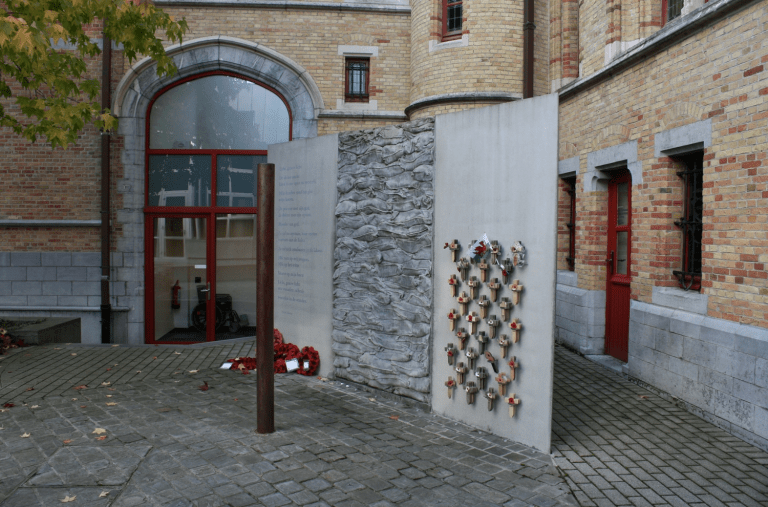
The first historical site was one of the grimmest – the condemned cell for soldiers about to be shot for cowardice. It’s an undistinguished stone room, tucked next to the Town Hall, no bigger than most people’s bedrooms. There is some graffiti on the walls, the odd crucifix or name: for some soldiers, it was just the cell for drunkenness. Those suffering the severest penalty – their paperwork now displayed as superior officers countersigned the death penalty – “I see no reason to change this verdict” – had maybe ten metres to walk to a steel post in the neighbouring courtyard. There’s a good site with further information here.
Walking back to our car, we passed Toc H. This was a soldiers social club, set up by a clergyman to provide an alternative to the bars and brothels that had shot up for the thousands of young men. A friend tells me the only rule was that you leave your military rank at the door.
We then drove to the second biggest cemetery in the Ypres Salient, which is quite a claim as there are 174 cemeteries in that battlefield area. This was the Lijssenthoek Military Cemetery, maybe a ten minute drive from Poperinge town itself. The reason it was such a large cemetery was that it was next to the biggest hospital in the Ypres Salient. Even if only three per cent of those admitted died there, that was enough to provide 10,000 graves. A neat modern visitor centre lies alongside the cemetery, and you can make out the railway lines that brought casualties to and away from the hospital. One room of the visitor centre is devoted to airmen of the Royal Flying Corps: casualties were very high there, and, it seemed, often as a result of mechanical failures or poor training rather than enemy action.
Ypres We drove off towards Ypres maybe 20 minutes away, finding the lovely Albion Hotel just off the town centre. The Grote Markt is that centre – an open market square made up of traditional Dutch style buildings housing shops next to the magnificent Cloth Hall, originally built between 1200 and 1300. It was utterly destroyed during WW1, and has been completely restored, opening again in the 1960s, and now housing a fine museum full of interactive elements. Testimony from locals and nurses as well as soldiers competes a sombre experience. Give yourself a couple of hours at least.
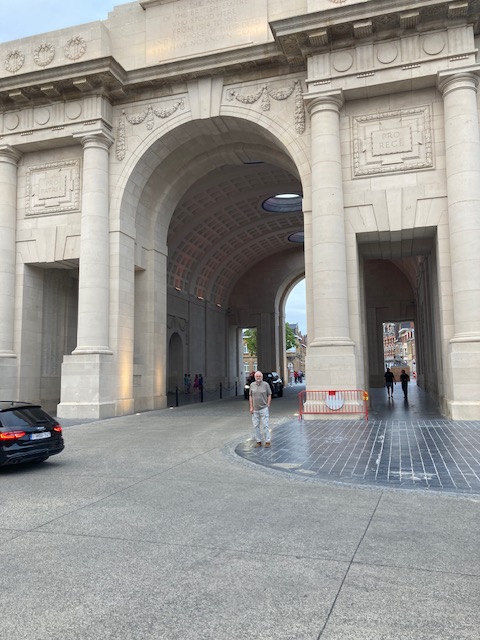
We’d got up at 5.00 am to leave London, so were pretty tired and had a lie down in the hotel, dining on a designer burger later and moving to the Menin Gate. This is a monument built into the city walls of Ypres, bearing the 55,000 names of those with no known grave (some tourist sites say it will be shut till 2027 for renovations, but they have now been completed). Each evening there is a brief service of remembrance there, arranged and supported by local Belgian people, and attended by visitors from all over the world. The place is packed. A bugler plays The Last Post, a brief poem is read, and wreaths are placed on the memorial. When we were there, this task was done by Boy Scouts from Chorlton in Manchester, and by Canadian Girl Scouts. Matters are ended by the bugler playing Reveille.
We dropped into the Commonwealth War Graves Commission office next to the Menin Gate. Milo and I knew of my relative buried further south, but we didn’t know if there were casualties on his father’s side. My son-in-law’s name is uncommon and that made it easier to discover Private John Leesley 241498, killed on 18 October 1917 – the only military casualty Leesley out of 1.7m dead[1]. That’ll be a grave more difficult to visit, though: the citation says he is remembered with honour in the Baghdad North Gate Cemetery.
Last stop was a local pub. Were it not for WW1, Ypres might be best known for its beers – lying in wait for the unwary on the bar menu at strengths up to 10% and beyond. The fields around, amid the maize and potatoes, often feature hop poles to feed that local industry. Ypres is now Flemish speaking – properly called Ieper. I speak moderate French, but local people were happier speaking English than French.
Day Two – Friday, 8th August 2025 Ypres We slept well, grabbed a decent hotel breakfast, and then met our guide for the day’s tour outside the hotel. Kimberley Wright was terrific – from the Wirral, now transplanted to Flanders to be a battlefield guide. We piled into a Mercedes people-carrier with an American father and son from Oregon, a Dutch and a Belgian couple.
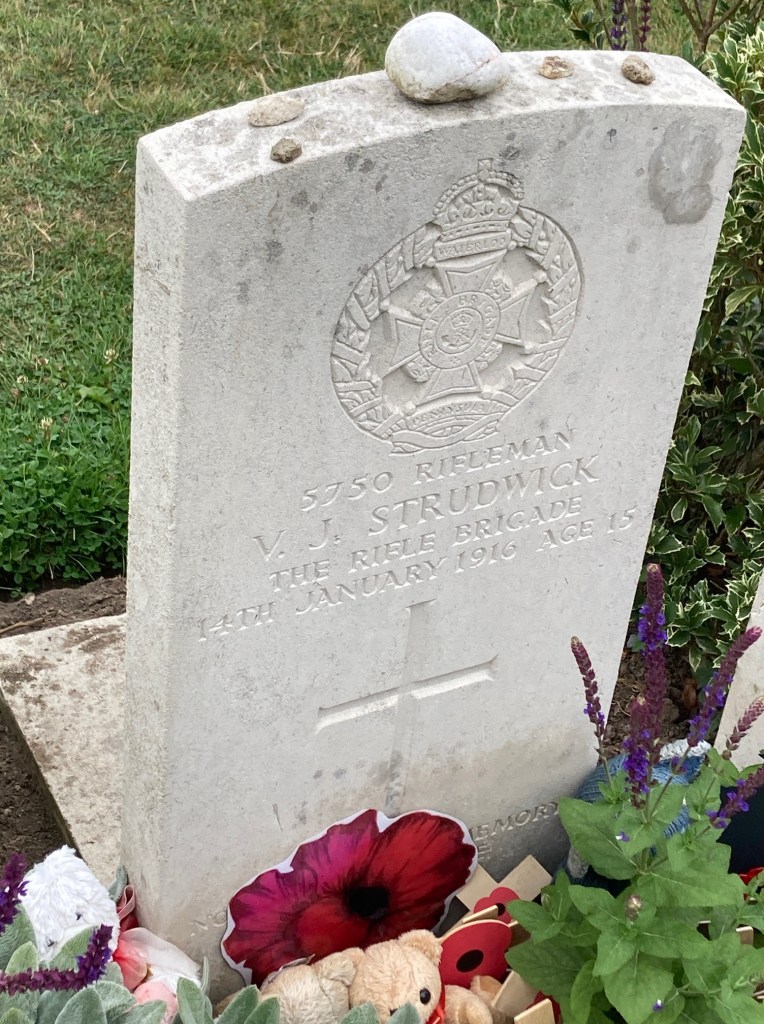
First stop was the Essex Farm cemetery. It was a poignant place to start. After a brief outline of the war’s beginnings, we walked over to the grave of Valentine Strudwick, at 15, the British Army’s youngest casualty. Boys this age enlisting was not uncommon, but this death caused an outcry by parents for their sons to be found and returned to the UK. A search was made, and eligible boy soldiers were told they could return without penalty. Many, however, resisted, feeling it would be letting down their comrades to go back home.
The Essex Farm cemetery is next to the Ypres Canal, which was the front line for a while, and the dressing station for wounded troops. This was in concrete, sunken to provide cover from enemy fire, dark and damp now but you can look inside. It provided first stage medical help for casualties – some hopeless, packed away from sight, given morphine, perhaps accompanied by a nurse in his dying moments, perhaps not. Others were easily patched up, and sent back, whilst the seriously injured but saveable saw their wounds dressed and cleaned before they were sent back to a hospital behind the lines or in Britain. Our guide spoke of the terrible wounds that were caused by modern artillery, often creating the appalling facial injuries that led to advances in plastic surgery. One man’s face was so disfigured that his wife divorced him: her disgusted friend carried on visiting, and eventually married him[2].
The doctor in charge of the dressing station at Essex Farm was a Canadian – John McCrae. He was moved by the death of a close friend to write the now famous poem “In Flanders Fields” that has led to the poppy becoming the emblem of remembrance.
In Flanders’ fields the poppies blow Between the crosses, row on row, That mark our place: and in the sky The larks, still bravely singing, fly Scarce heard amid the guns below.
We are the dead. Short days ago We lived, felt dawn, saw sunset glow, Loved and were loved, and now we lie In Flanders’ fields.
Take up our quarrel with the foe; To you from failing hands we throw The torch; be yours to hold it high, If ye break faith with us who die We shall not sleep, though poppies grow In Flanders’ Fields.
Notice that it isn’t a pacifist poem, unlike the work of Owen, Graves, Rosenberg or Sassoon. We are told that we must carry on with the fighting or betray the valour of the dead, Maybe McCrae changed his mind on that: he is alleged to have become more fractious and depressed, his final diary entry in January 1918 saying “I keep working, but they keep dying” before he himself died of pneumonia a week later. The footpath from the canal to the casualty station is named McCraepad – McCrae Path.
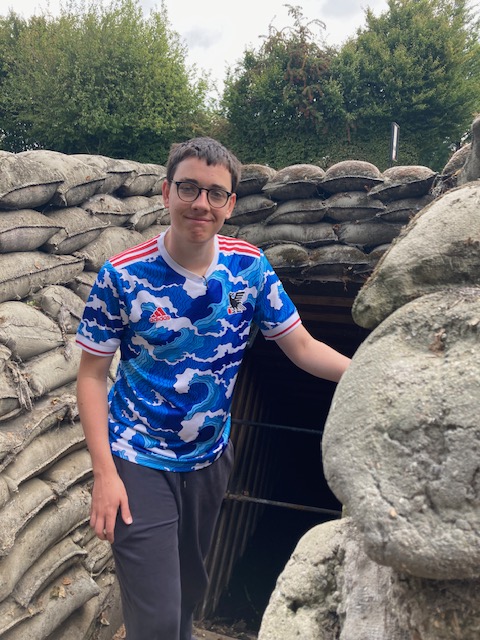
We climbed back into our minibus, and drove to the Yorkshire Trench, discovered in the 1960s as a new industrial estate was built. The remains of 155 French, German and Yorkshire soldiers were found as well: even today, between thirty and forty bodies are found in farms and fields around Ypres each year. With Flanders’ high water table, the trench and dug-outs were completely full of water, but this enabled the preservation of many artefacts – timber trench-frames, bunks, blankets, razors – even the pump was found to be in working order. The subterranean areas are not accessible, but their outline is traced above ground by gravel paths that indicate the size of the various facilities beneath.
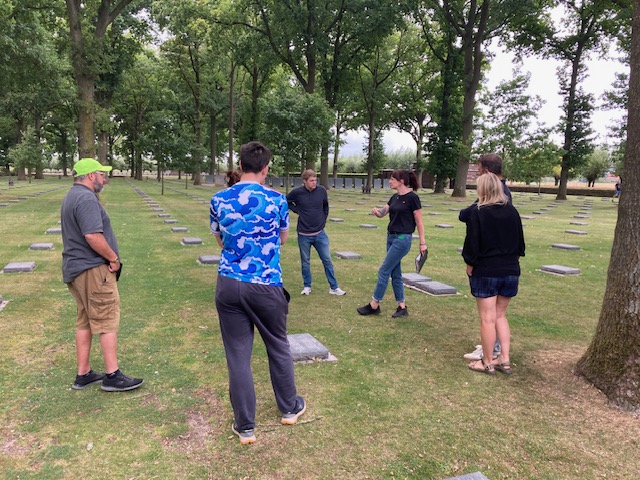
The German cemetery at Langemark was next, and Milo found it a highlight. The design was, if such was possible, more sombre than the Commonwealth graves – black stone, level with the grass, no flowers or shrubs, and a large uneven area holding, it is said, 20,000 bodies. The area is subject to myth making – ‘birds never sing there’ (they do), German bodies were buried upright (they weren’t) and such. What is true is that this area is the site of the Kindermord – the ‘massacre of the children’ – German student volunteers who joined up eagerly in 1914[3], and were mown down by their first encounter with the experienced professional soldiery of the British Expeditionary Force. After German forces overran the area in 1940, Adolf Hitler came to this site to give an oration, claiming (it is said) that he was there. He had a genuine war record, but it wasn’t here.
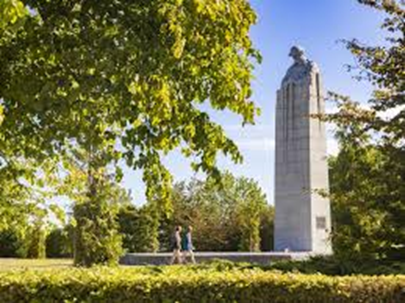
The next location that Kim took us to was the St Julien Memorial, now more commonly referred to after the statue that marks it – The Brooding Soldier. This was the site of the first poison gas attack in the war on April 22nd 1915. The Germans released the gas when the wind was blowing from their lines, causing French colonial troops to break and retreat, leaving a 5 mile hole in the Allied defences.
The Germans were slow to realise the success of their new tactic, enabling French and Canadian forces to come forward to fill the gap. In the 48 crucial hours that they held the line, 6,035 Canadians – or one man in every three who went into battle – became casualties; of that number, approximately 2,000 (or one man in every nine) were killed. The parkland around the statue features Canadian shrubs, one of which – a low green bush – ghoulishly mimics the look of chlorine gas creeping over the ground.
Tyne Cot We finished our tour at the largest cemetery for Commonwealth forces in the world, Tyne Cot. Named by soldiers from Northumbria because of the resemblance of pill-boxes to workers’ cottages on Tyneside, it contains more than 10,000 graves. Many of these died in the Third Battle of Ypres, known more commonly nowadays as Passchendaele. The cemetery is, like all the others, beautifully kept. Being located on higher ground, our guide was able to point to some wind turbines maybe five miles away, where the advance started in July 1917: we could walk there in a couple of hours, whereas the soldiers took five months to gain the ground,
The minibus took us back to the hotel. It had been a terrific tour, taking us to places we would have missed, and enabling us to talk to other visitors. We were pretty tired, though, grabbed a late lunch snack, and collapsed in our hotel with a drink and a rest. I decided to look at the ‘cathedral’ – Ypres St Martin’s Church, finished 1370[4]. It’s actually no longer a cathedral, as Napoleon got together with the Pope to reorganise Belgian bishoprics, but it was an impressive building nonetheless, in the sombre Dutch style. It’s a centre of organ music, and though I missed the recent festival, organ music still played as I walked around. The most ‘distinguished’ person buried in the church was Cardinal Jansen, the originator of Jansenism. Different heresies are a mystery to me, so I looked it up. It’s a bit like Calvinism – the idea that an individual’s fate is determined not by virtuous behaviour but by the grace of God, about which you can do nothing. God, it is argued, does not grant you free will. As an atheist, I find most theistic beliefs odd, but this one is not just weird but unpleasant, a sort of religious bingo where you simply see whether your number comes up. People fought, died, were prepared to be burned and tortured for this stuff, so they were sincere enough. But reasonable, logical, sensible ? Hmmmm …
We ended the day having a great meal in a restaurant called the Captain Cook (always appealing to those of us with Middlesbrough connections). Milo had an epic calzone, I tucked into the chicken in mushroom sauce followed by the (inevitable) Belgian waffle. We fell into conversation with diners on the next table from Malton, who tipped us off about the site of the 1914 Christmas truce, maybe 15 minutes’ drive from town. That decided our first stop on Saturday.
Day Three – Saturday, 9th August 2025 Auchonvillers After a good night in our nice hotel, and an ample breakfast, we checked out. The plan today was to drive south to the Somme, another area well known for its WW1 associations. The car had charged fully overnight in the hotel car park (excellent) giving us 350 miles in the battery, no problem given the Somme was maybe 70 miles away, at most 90 minutes of leisurely French motorway driving. But we were going to take a modest diversion – of which, more anon.
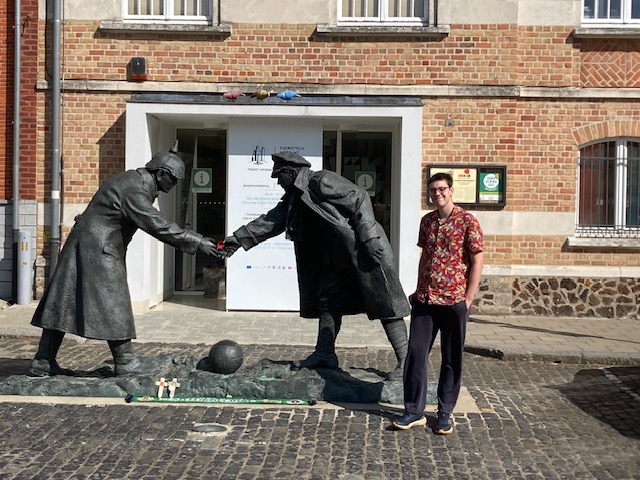
First stop of the day was at Ploegsteert, or Plug Street as English soldiers called it. On Christmas Day 1914, hearing carols being sung, soldiers climbed out of trenches, exchanged gifts, and played some impromptu games of football. They also took the opportunity to collect and bury their dead.
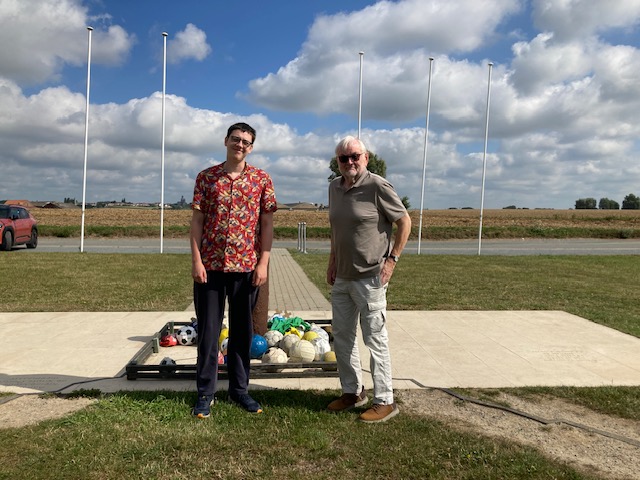
The episode has attained mythic proportions, but it certainly happened, and is commemorated by a bronze statue in the town square of the nearest village, and a FIFA sponsored stone memorial, signed by Michel Platini, five minutes away at the actual field. A couple of French hikers obligingly took our photo. There remain some trenchworks at the memorial site, and a look around the local landscape shows cemeteries on both sides. It seems pretty clear that, after the Christmas truce, the armies on both sides reverted to business as usual.
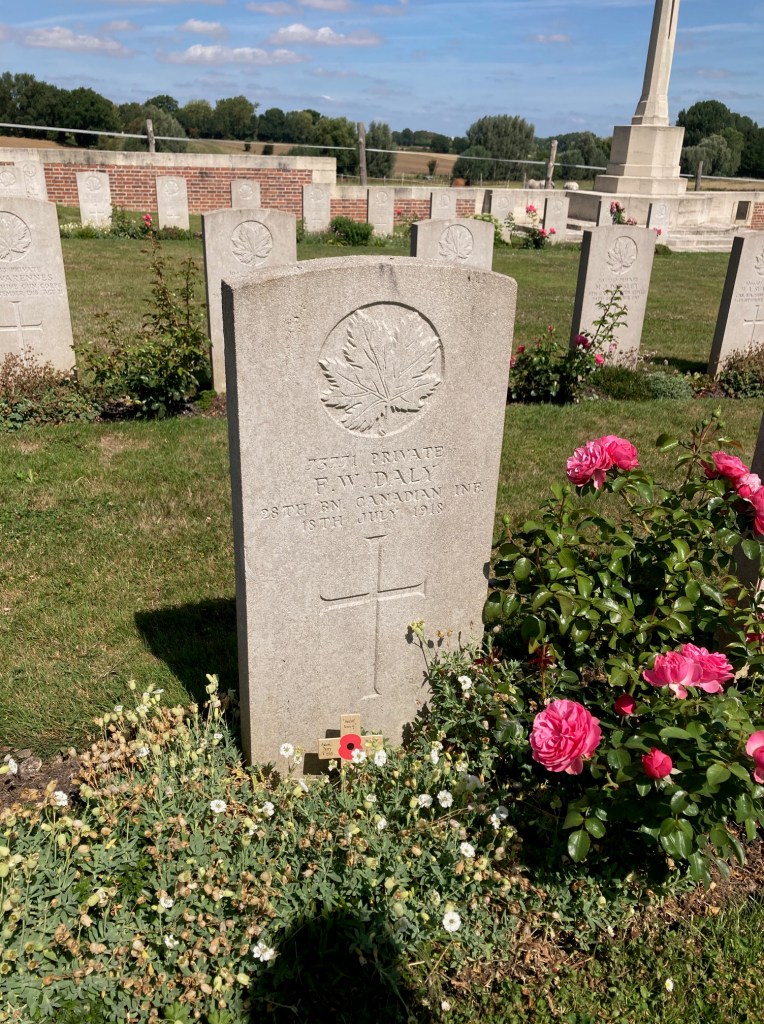
Wanquetin We then drove over the invisible Belgium-France border towards our next destination – the grave of my great uncle, Fred Daly, known as “Sonny” in the family. He was my grandmother’s brother, and emigrated to Canada before the war started. When war broke out, he enrolled in the 28th Battalion of Canadian infantry, which was known as the North-Western as it recruited in Manitoba and other far flung provinces. He served throughout the war, being killed with 14 comrades when a German aircraft dropped a bomb on their sleeping quarters on 18th July 1918. The family legend was that he was a horseman, and was killed when he came out to calm the horses who were spooked by artillery bombardments. The truth is found in the battalion records, which are available on the internet in astonishing detail, day by day, here. You’ll notice that the battalion carried on the next day with a sports day against a neighbouring unit as if little had happened.
The Commonwealth War Graves Commission keeps immaculate records, and they placed his grave at Wanquetin Community Cemetery – a small local addition to the ordinary cemetery of a modest Somme village, on the outskirts of Arras. We walked through that graveyard, full of local memorials of varying taste, some of which had notification from the local council that the grave was neglected, and would be taken over unless the Town Hall was contacted within the year. Other graves had individual names with birth years but no death date, indicating that it was a reserved spot for a family member still living locally.
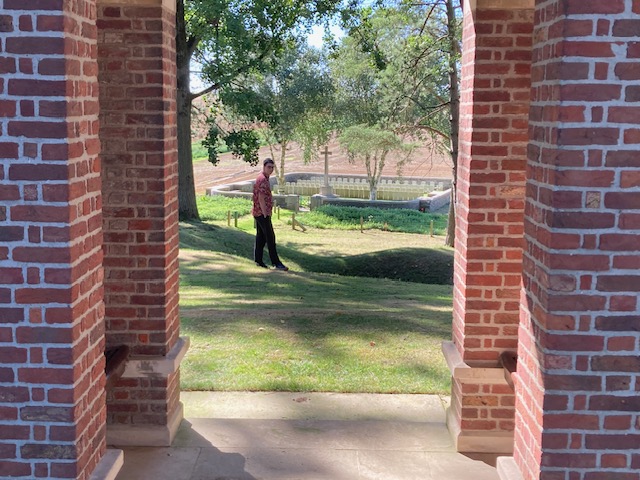
The extension which makes the military cemetery is beautifully kept. The grass between the gravestones is neatly mown, and the stones themselves are set amid low growing shrubs and flowers. The grave is easy to find, as the end gravestone on each row has a reference number – Frederick Daly’s was II B 15, and lay alongside the other members of his detachment killed in the same incident. We had bought one of the little pine crosses from the Ypres Museum, written our message, and pushed it into the ground at the base of his stone. We were the only visitors to the military section. The countryside nearby was lovely, helped by glorious summer weather. The field behind the war memorial held a group of magnificent horses.
Pt Daly died in 1918. This area is better known for the 1916 Somme battle which was launched to relieve pressure on the French Army, which was being remorselessly attacked around Verdun and was suffering mutinies. The planning, however, was poor. Troops were assured that preliminary shelling would destroy the German defences, but when they rose from their trenches they found the Germans had been fore-warned, and spent the bombardment in deep shelters, ready to emerge as soon as the Commonwealth troops appeared. 10,000 British and Empire soldiers died on 1st July 1916.
Modern historians differ from the Blackadder “lions led by donkeys” view of the Somme, maintaining that it was a necessary battle, and the losses imposed on the Germans were crushing. You get the idea in this YouTube clip – but I remain of the old school, that (as one commentator out it) “gaining seven miles for 600,000 casualties cannot be claimed a success”. Not a debate to enter into here, except to say that (a) the Germans subsequently withdrew from the contested area, enabling allied troops to simply walk across the battlefield and (b) later generals like Sir John Monash combined tanks, smoke, artillery, air power – technology that was available in 1916 – in combined attacks that made great gains for a fraction of the casualties.
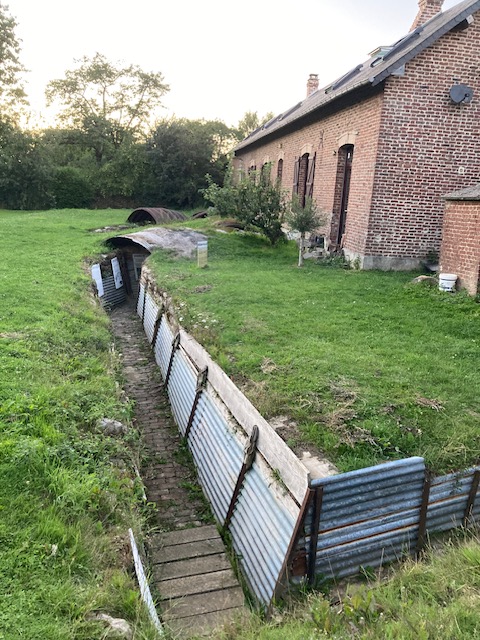
Ocean Villas We’d booked in for the night at a B&B run by a celebrated Englishwoman, Avril Williams, at the village of Auchonvillers, near the Beaumont Hamel battlefield. As elsewhere, the Tommies gave it a pronounceable English name, reported by the poet Edmund Blunden who used a farm building on the site as his pill-box, as “Ocean Villas”. The building that Avril has converted into such a nice B&B was once a farmhouse, and its cellars were used as a dressing station for casualties. The trench at the back of the house still exists, as does the cellar.
The other guests were British (one was a businessman who worked in Milan, and decided to bring his half-Italian son along as he drove to visit relatives in England) and most were history buffs. A couple of friends were, I guess, from the services as they joked over breakfast about having to learn Morse code. Another guest was head of history at a high school who decided to retire early and become a battlefield guide. He and his wife come out several times a year. The B&B is close to many Somme sites, so we dumped our bags and used the afternoon to visit two that were both less than five miles away. One was the Newfoundland Monument, remembering the Canadian dead of the Somme, and the other was Sheffield Memorial Park.
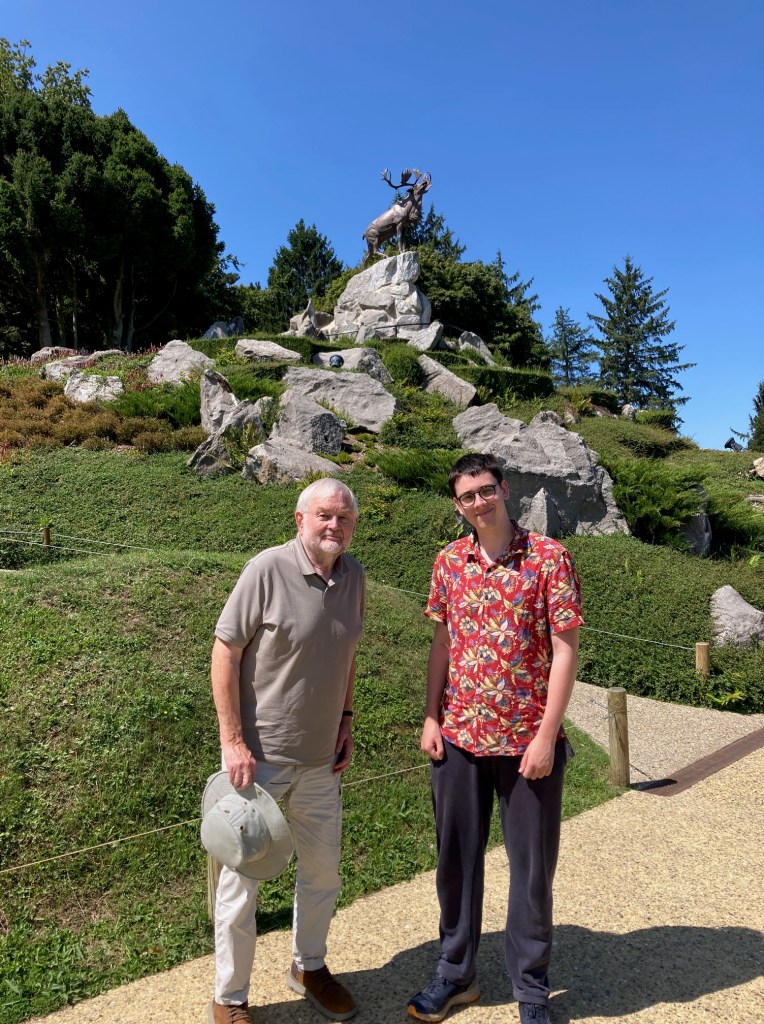
The Newfoundland Monument is set on the actual battlefield the Newfoundland Regiment fought over. The trenches are still there, though now grassed over amid the trees. At the centre is a mount crowned by the statue of a caribou, the badge of the regiment that fought here and suffered appalling losses. The Newfoundlanders had been told that there were insufficient men from their province to make a separate regiment so they’d be integrated into other Canadian units: they refused. There is a well-kept and modern visitor centre, which includes a photograph of the first group of families to visit the site after the end of the war.
The park is supervised by young Canadian men and women in park ranger uniforms, who are happy to guide groups, direct visitors to points of interest, or just take a photograph (see left).
Sheffield Memorial Park was the next point of interest. We drove there in ten or fifteen minutes, passing seven substantial cemeteries on the way. You get to the Sheffield Park and its three associated cemeteries up a bumpy agricultural lane. Warned that the local farmer was getting fed up with visitors blocking access for his tractors and harvesters, we tucked the car next to a cemetery wall, and walked the last 500 yards or so, past waving maize fields. The park is now wooded, though the outlines of shell holes are plain enough to see. It contains a memorial building, with a book of remembrance. By 1916, the British army was no longer made up of experienced professional soldiers, but was mostly volunteers. Amongst these were the “Pals Battalions” formed from neighbourhood groups or factory co-workers. On July 1st, by 0750, half an hour after the first soldiers had emerged from their trenches here, the attack had failed. The Accrington Pals suffered 585 casualties, the Sheffield Pals 513, the 1st Barnsley Pals 286 and the 2nd 275. The devastation this caused to small towns led to the idea of Pals Battalions being quickly abandoned.
So then it was back to an evening meal at Avril’s establishment, with guests sampling Belgian and French beers whilst we retreated back to our room and slept.
Day Four – Sunday 10th August 2025
The day started with a full English breakfast, with some of the eggs coming from the chickens that clucked their way around the estate as if they owned the place. We’d heard from other guests that the B&B had its own museum, and sure enough, our hostess showed us across the road to a converted barn that contained a treasure trove of items discovered in fields, donated, or bought from other museums. Having seen the Blackadder episode about shooting General Melchett’s favourite bird, we were interested to see a public poster warning that the penalty for shooting a carrier pigeon was £5 – £500 in today’s money, but at least not the firing squad. There was also a room of WW2 artefacts, with a complete Willys Jeep.
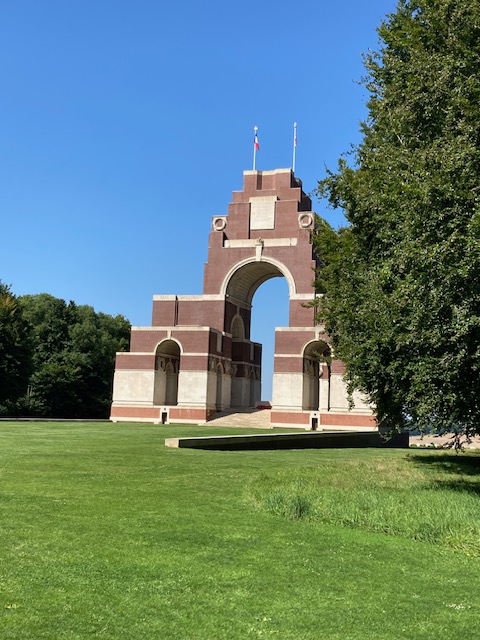
Thiepval Monument It was our last day in France, and we were due on the LeShuttle at 19.30, so we needed to pack some unmissables in. One was the Thiepval Monument, another enormous brick and limestone construction that commemorates those 72,000 who died with no known grave, all of whose names are to be found on the massive walls. So many died that those with common names – J Clark, W Smith and so on – have to be distinguished by their army numbers. There was a French museum nearby, but we were pretty “museumed out” by this stage, and just walked across the immaculate lawn to Sir Edwin Lutyens masterpiece. I say masterpiece. It was described by Gavin Stamp as “the greatest executed British work of monumental architecture of the twentieth century”, and the design of interlocking victory arches allow all the names to be read by visitors, but I found it overbearing, almost clumsy. As ever, if you stand on the plinth and look around the countryside, within 400 yards there is a cemetery full of young men whose grave is known.
Arras Time was catching up with us, and Milo wanted to spend some time in a normal French city, so we pulled in to Arras, which was halfway to our next destination.
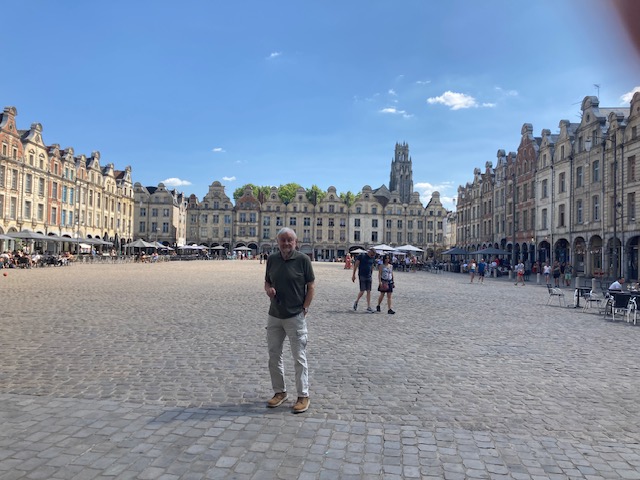
Not knowing the city, I aimed for the cathedral, but that seemed dull and remote so we parked up in the massive Grand- Place. This turned out to be an impressive square, surrounded by houses and shops in what is known as the Baroque Flemish style. It does indeed look very Dutch to English eyes. We needed food – we weren’t going to be back in London till late evening – so settled down to a solid lunch – the Camembert salad was too big even for my appetites, and Milo marvelled that the waiter asked him precisely how would like his burger to be cooked. Rather than order a pudding, we decided to do some more town walking, ending up in front of the Town Hall with an emotional sculptural memorial to the dead of the 1940-44 resistance. This square was equally impressive, and came equipped with an ice cream stand that served our dessert needs.
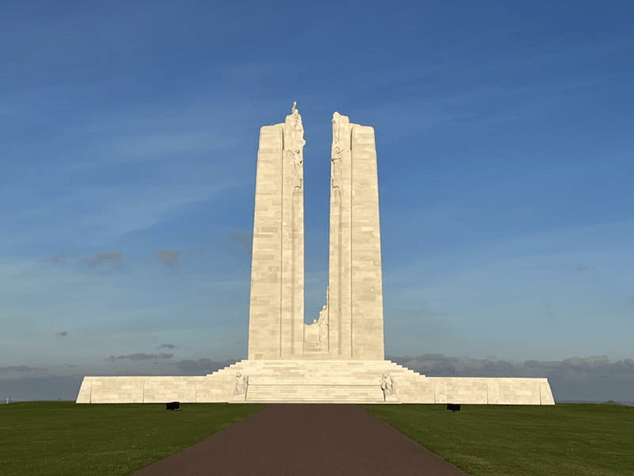
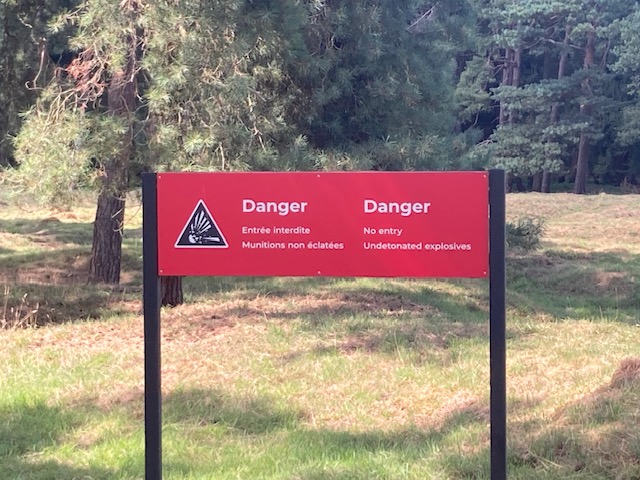
Vimy Ridge was the last, and in many ways the most impressive, of all the memorials we visited. It stands on high ground with extensive views over the surrounding countryside (and a few coal heaps). The battle took place in 1917, and Canadian forces, working together at last, conquered the ridge that had defied many previous attempts by the Allies. One attempt was by the French Moroccan regiment, who in 1915 dislodged the Germans from the crest, but had to withdraw when reinforcements failed to arrive. They have a memorial nearby also: I’ve learned that many of these troops were in fact Senegalese, which may account for the colourfully dressed African women whose photo I took on our visit.. We’d left the car in a car park maybe 800 yards from the ridge’s edge itself. The way to the monument was clear, a straight walk across mown grassland. Milo would have preferred to approach through the battle area, where shell holes and defensive positions were still evident, and trees provided shade on a hot day. This wasn’t possible. As we got nearer the monument, that way was prevented by electric fences, and regular notices warning that the ground was still full of unexploded ordnance.
The monument itself is in magnificent white limestone, and has a much more artistic and sculptural feeling than the brick and Portland stone of Menin Gate or Thiepval. It also has an air of mourning, with a female figure prominent. As with many other monuments, the names of those with no known grave are engraved on the monument, though Wikipedia suggests that the architect protested this was not part of the original plan.
And with that, our trip came to an end. Calais was maybe an hour away, and we decided to arrive early at the tunnel to see if we could catch an earlier train, as we had when coming to France. This was a mistake. You have to arrive an hour early to embark anyway, and ‘technical difficulties’ mean that trains were an hour late, not early. In brief, we ended up spending nearly four hours at the terminal – not a disaster, but a downbeat end to a fascinating holiday. We arrived at my brother’s house in south London at 10.00 that evening, grabbed a beer and turned in.
Conclusion I was impressed by the interest that is still shown in the battlefields of WW1’s Western Front. I wondered when the sense of remembrance will wither away, but the answer is not anytime soon. Tourists still visit the sites, and the Menin Gate ceremony is positively crammed full. Many graveyards had no visitors- like Wanquetin until our arrival – but they are beautifully maintained by the Commonwealth War Graves Commission, sometimes (as at Ljissenthoek) by the descendants of the first gardeners who came across from Britain in 1919. The cemeteries are carefully signed from main roads. The larger ones have modern visitor centres, expertly staffed and free to enter like the car parking.
I said earlier that we got a bit “museummed out”, and I think had we stayed longer we would have wanted to do more battlefield walking, understanding where the forces stood and their movements. The Imperial War Museum’s London site has a trench experience which might have been a good preparation for us,
I’ll end with thanks to those involved. My brother and sister in law, Simon and Jackie, live in Eltham in South London, conveniently close to the M20 and they played host to our adventures. They could not have been kinder. The bookings of hotels and tunnel were done promptly and efficiently by James Power of Somme Battlefield Tours, who provided maps and suggested routes and tours in the battlefield areas. We could go back and follow his ideas for weeks, and still not scratch the topic. Kim was a great guide, highly recommended if you’re tempted do a similar trip in Flanders.
Main thanks go to Milo Leesley, my navigator and co-conspirator. He showed extraordinary tolerance and good humour for a 17 year old: when the American teacher on tour said “young people don’t read books these days”, he smiled quietly and returned to his well thumbed copy of “Oliver Twist”. He put up with what would be, in a weaker man, a fatal level of anecdotes from me. It’s also useful to have someone to tell you to drive on the right first thing in the morning, and operate the toll gates on French motorways. One of the motives for going was hearing a favourite song “The Face of Appalachia” by John Sebastian, about a grandfather who promises to take his grandson on a walk in the Appalachians, but never gets round to it[5]. I’m 80, and Milo is off to Leeds University next month, so, as I said earlier, we ran it close, but we did get round to it.
[1] There is a civilian casualty – John Leesley, who died in 1940 during the Second World War bombing of Sheffield. He was killed in the Hermitage Pub, where his relatives many years later gathered to celebrate a Sheffield United promotion.
[2] Another advance was the use of X-rays quickly after the wound. Marie Curie herself – with her 17 year old daughter – organised the French Red Cross X-ray unit, using lorries to carry portable equipment that could be used to help treat casualties with metal fragments
[3] Reminiscent of the scene in both versions of “All Quiet On The Western Front” featuring a university professor urging his students to join up.
[4] And (of course) utterly destroyed in WW1, rebuild to the original design in the 1920s
[5] Actually, the best version of this song is by Valerie Carter, on her utterly wonderful and totally neglected album “A Stone’s Throw Away”.
Anyone who is a regular user of X/Twitter will know the rules, one of which is – never respond to an American gun nut. If you are unwise enough to ignore this rule – perhaps after the latest school shooting, perhaps by suggesting that it is unwise to allow mentally unstable people to have access to military hardware,- you will be deluged with responses.
There are two main responses. One involves saying that gun ownership is a constitutional right. This actually rather dodgy. The constitution speaks of not infringing the right of a citizen to own guns as part of a well-regulated militia. To most people, this would involve a coherent organisation with memorandum of association, a membership system (in which you couldn’t own a gun if you didn’t fulfil the entry conditions), and a hierarchy of management (in which action could not be taken without authorisation by a supervisor selected according to the organisation’s rules). None of this appears to be present in gun friendly states. It may be worth adding, too, that even this right comes as part of an amendment to the constitution, which implies it could be repealed (as the ban on alcohol was, and denial of votes for women too). You can surely change a constitution if it helps save lives.
The other main response is also curious. It defends the ability to freely own arms as a way to maintain the freedoms of the population, enabling them to resist oppressive governments trying to take away citizen’s rights. The (slightly paranoid) view is that governments are eager to remove freedom of speech and assembly and other rarely specified stuff. You sometimes have the circular argument that guns are needed to resist legislation to control guns.
My problem with this argument is that it is patent nonsense. Someone equipped with a rifle they have bought from a gun shop could never resist a government, which has tanks, attack aircraft, warships to back up police, FBI and CIA agents. Even nations with not just guns but (slightly fewer, or slightly inferior) tanks and aircraft have been unable to resist the awesome power of modern weaponry. I’m sure the French and Polish peasantry of 1940 had plenty of shotguns, but it didn’t get them far preserving their civic rights against the Gestapo.
We can also see plenty of examples of US citizens losing, or failing to gain, their rights, without help from weapons. Guns were useless in gaining votes for women, or securing civil rights for many black Americans. Chinese migrants lost their rights to citizenship as part of the ‘Yellow Peril’ at the turn of the 19th/20th century. Innocent and patriotic American citizens of Japanese origin were moved to detention camps in 1942. Neither group were helped by gun laws. One suspects that the argument made here is “well, not those sort of rights”, or perhaps even “well, not that sort of citizen”. Abortion rights, or even the right to access all and any book in a public library or school, also seem to be outside the protective magic of the bullet.
There are other arguments. “Guns don’t kill people. People kill people” is common enough, and could be used to justify selling cyanide, attack helicopters and tactical nuclear weapons. The idea that a substantial force of guards could be set outside every school to await the next gun toting oddball would be more convincing if there wasn’t evidence of this, er, not working.
Finding apparently noble reasons for doing what you want has a long history. Aristocrats tell us they should stay in the UK Parliament because their families have served the nations well. We are told we don’t need to cut hydrocarbons because, well, it damages the economy and anyway this climate change stuff is untrue. Millionaires, it seems, don’t avoid taxes because they’re selfish, but to create jobs and boost the economy. Social entitlements should be cut, not as a miserable attack on the less fortunate, but because they encourage laziness. Action to reduce speeds and cut road deaths, we are told, is part of a war against the motorist. Reducing ill health and obesity by controlling fast food is similarly just the nanny state in action.
A confession: I’ve been out shooting with American relatives, and it’s fun. I guess the gun lobby actually thinks “I like having my guns”, and will dredge up any apparently worthy argument to keep them. Even if it results in hundreds of deaths a year, many of them children.
I haven’t posted for a long time, mostly because I can vent my rage on X/Twitter, and partly because I’ve started a long post on the economic record of Labour governments. It’s a topic that books have been written on, but I wanted to do a summation to see where the public idea that Labour’s heart is in the right place but they can’t run the economy is justified comes from. It’ll take a while, and I’m also spending time improving my French and learning the guitar. Yes, not a good excuse, I know.
In the meantime, I wish you a happy new year and pass to you a brief note on silly memes from TV detectives (what has become called “cosy crime”):
Interviewing suspects or witnesses when walking down the street. Eh ?
Interviewing suspects, witnesses or informants whilst others are present. Eh ? Eh ?
Suspects who say, when interviewed by the police, “you’ll never prove it”. A more stark admission of guilt I’ve never seen – has any suspect ever said that ? Wouldn’t it, in any case, make detectives even more determined to nail him ?
Suspect laughs unconvincingly. Who does this when accused of a serious crime ?
Suspect says “This meeting is over” and walks away. Does that happen ? Can you do that, even if you declare beforehand (another meme) “I’m a very busy man”.
Suspect asks “why would I ?”. Doesn’t happen.
Detective has medical condition that requires pain-killers which are taken without water. Dr House can also do this, but I can’t. Can you ?
Interviewee carries on playing snooker/pool/cards whilst being questioned.
Locked door is charged down on the third attempt. Never the second, never the fourth. Third. Always.
When escaping from the villains, a couple are slowed when the woman twists her ankle. Male ankles, I can assure you from personal experience, are perfectly capable of twisting. Nice to know this never occurs when pursued by gangsters/foreign agents/serial killers.
Hiding behind a car door when under attack. Plenty of tests tell you that doesn’t stop the feeblest gunfire.
One inch of whisky seems to be a satisfying drink that lasts a while.
That’s enough for now. All further contributions welcome; there must be thousands.
I’m a great fan of TV detectives, and also of film noir, so I settled in to the latest incarnation of “Perry Mason”, and it didn’t disappoint. Matthew Rhys carried off the role superbly, as you’d expect if you had followed “The Americans” (and “A Beautiful Day In The Neighbourhood”). Sufficient money had been thrown at the production values to ensure a terrific supporting cast, great sets and locations plus, or course, the vintage cars. I had also been a fan of the old Perry Mason, as played by Raymond Burr long ago enough to be part of family memory, of sitting round the TV when it was black and white, there was no recording or time-shifting, and just the two channels.
But the two versions are very different. Burr’s Perry Mason is an established lawyer, with what seems a lucrative practice. Rhys’s version is shabby and down at heel, short of money to the point of being thrown out of his rented home at one stage. Burr’s Mason has an endless supply of well-cut suits and crisp white shirts, but Rhys is crumpled and sweaty. Personal traumas never affect the 1950s version of Mason, whereas the private life of the 2020s incarnation is just a mess. These changes were matched in the lawyer’s team. The 1950s Paul Drake was a rugged quarter back sized guy, with nothing to stop him meeting Parry’s investigatory needs: he was played by William Hopper (yes, the son of Hedda Hopper). The modern version is black, played by Chris Chalk, as brave, reliable and honest as his predecessor but bitterly plagued by the era’s endemic racism: his principles mean he has to scratch for his living, to his wife’s despair. Della Street, Mason’s PA, was archetypal 1950s TV woman, straight and white and obedient: the new version is equally competent, maybe more so. She gets more involved in the plot than the older Della. Oh, and she also has a sex life, and it’s gay.
So, which is the more accurate ? Erle Stanley Gardner, the author of the books, was himself a lawyer. He had an admirable career representing the poor and oppressed, seeking justice for the wrongly accused. He set up a pressure group – the Court Of Last Resort – to help right miscarriages of justice. He turned out 85 Perry Mason books, and other books too. At the height of his popularity, he was selling 26,000 copies a day, though his popularity waned and most of his books are now out of print. So when I wanted to find out which was the more accurate representation of Garner’s character, I had to resort to the internet and its wonderful ability to conjure up books printed on request. Off I went on holiday with “The Case Of The Stuttering Bishop”, expecting to find in it evidence of how the modern Perry Mason was just a woke rewriting of the original.
And I was wrong. The Perry Mason in the book may be less down-at-heel than today’s version, but he is willing to do things that I think would be unlawful today, and might have been so in 1936, when the book was written. He’s willing to smash an offender in the face with his fist. Evidence is found and concealed. There are things in the book that would – what’s the expression – “offend modern sensibilities”. Sadly, there is a woodpile involved as one of them. On a less offensive note, the cleric of the title is assumed to be a fraud because no-one would appoint a bishop who has a stutter. Cigarettes and whisky are never far from the action.
What else ? Hamilton Burger is not the resolute opponent of Mason he is in the early TV series: he’s willing to work together with our man, listen to explanations and change his view. Paul Drake and Della Street are as involved in the action as in the modern version, much more so than in the 1950s (though Drake is not above telling Della that women should stay out of crime detection). They are happy to argue with Perry when they think he has got some ideas wrong.
I’m not sure, when looking at literary adaptions, whether there is a lot of point arguing about what is true to the original. Shakespeare’s plots are often lifted from contemporary sources, and given a tweak or two. But in a world where we are often told that “you wouldn’t be allowed to get away with that today”, it’s good to check, and maybe find plenty of today’s stuff that is a pretty accurate version of what authors got away with in the 1930s.
Footnote: I know there have been many other versions of Perry Mason, both before and after the Raymond Burr version. Some became feature films – including “Stuttering Bishop”. There have been TV series, too. I’m sure they are workmanlike, and they have interesting features (Paul Drake is played by the real life son of the actress who played Della Street in the Burr version), but they never grabbed me like the two classic versions above.
Further footnote: I’ve been enjoying “The Lincoln Lawyer” on Netflix recently, a creation of the wonderful Michael Connelly. It struck me that there are parallels with Perry Mason. Haller has a Paul Drake figure called Cisco. He also has a Della Street character, Lorna (who is Cisco’s partner and Mickey’s ex-wife). And, of course, there are adversarial DAs who end up being drubbed in court by our hero.
Yet again we are hearing proposals for the establishment of specialist vocational colleges: we’ve heard this under a range of education ministers, of both parties and over several decades. This sounds sensible: the UK has many skills shortages, and specialist institutions seem to work in other areas like medicine. Why not establish a Voxbridge that will develop the excellence in technical skills that we need? Well, because the idea is neither practicable nor sensible. The reasons are:
We do not need a few superb electricians/builders/social care/IT technicians. We need lots of them, good and competent, all over the country. They have been provided in the past by several hundred further and technical education colleges – the ones who have suffered the deepest education cuts in the past decade. It’s not an elite issue.
No-one is quite sure what is meant by specialisation. Does it mean a college that does just one subject – (eg) electrical installation – and nothing else ? Wouldn’t that be impractical ? Would it do that subject at all levels, from elementary to post-degree ? Outside four or five major conurbations, the volumes would not be there to support such a college, unless we moved students from all over the region to halls of residence, which would be very expensive, impractical for adults who form the bulk of the workforce (and require grants and bursaries denied to all other students).
Specialist colleges in the past proved more expensive than general colleges, and were kept alive by a funding fudge factor; despite that, some had to be rescued by merger with a larger neighbour. How long will the Treasury smile on the extra expense ?
Is it proposed to establish an elite institution in every vocational area, from hairdressing to horticulture ? Really ? Will Scarborough send its apprentice hairdressers to Bradford ?
Existing FE colleges already have specialist departments. They may be general colleges, but not all have every vocational area, because (eg) catering, building or engineering require critical student numbers and expensive equipment. Skills like motorcycle engineering, dental technology, carpet technology, musical instrument repair, are already specialised departments in general FE.
Even beyond that, there is a sense in which within general FE colleges, the actual provision is specialised now. The plastering lecturer teaches nothing but plastering, the drama teacher just drama. Some departments are very large, occupying separate buildings. Why would a 400 FTE student specialist college be better than a 600 FTE department in a general college ?
There have been a number of similar initiatives, and all have failed. University technical schools lie empty, Colleges of Vocational Excellence provide just a badge on the boardroom wall. In any case, the students could only come from existing providers: what legal provision could shut down an existing autonomous college’s engineering or IT department, and insist on student transfer ?
Some specialist colleges exist, and some are excellent; I remember being very impressed by Leeds College of Building. Broadly, however, the research I have seen shows no general correlation between the breadth of a college curriculum and student success. DfES researchers, Strategic Area Reviews and Ofsted have looked and found nothing. Indeed, (eg) when I worked in this area, art departments in general FE colleges got better Ofsted grades than those in specialist art colleges. We actually don’t know. “Specialization is an under-researched area in the UK, and much of the material is too old to be of use” said a survey. I once read every inspection report in England’s colleges, and the very best were the tertiary colleges that met the widest range of local need.
Many FE colleges started as specialist colleges – of mining, textiles, engineering, construction and so forth. They broadened their curriculum to stay solvent, spreading costs more widely, avoid the effect of recession on (eg) building enrolments, represent the changing technical world and to improve the student mix and learning environment. As noted above, many colleges have merged simply to stay alive.
Careers services and adult advice centres have been hollowed out under this government. How would students find their way to Voxbridge ? And it may come as a surprise to policy makers that adults do not retrain to do their existing job better: they retrain to do a better job, or a different job. The idea that adults with family responsibilities in the midst of a cost of living crisis will take on substantial loans in order to do their existing job better for no more money only has to be stated to be shown to be fanciful
In summary, then, specialism is an idea that has often been enthused over but rarely thought through. Colonel Ghadaffy thought it was a great idea for Libyan secondary schools: on a visit to Libya, I spoke to an official who despaired that the only secondary school within fifty miles for his daughter, who wanted to be an engineer, was a languages school. Its very definition is not clear, and it looks like turning out an expensive flop, if ever delivered: which it won’t be. In my view, the debate reflects two general problems with UK education policy
Agnosticism – even boredom – about the effectiveness of local structures – whether, overall, one system is better than another. There is an obsession with the performance of individual institutions (‘academies’, ‘beacon schools’, ‘failing schools’, ‘coasting colleges’ and all that) but little interest in the effectiveness of the service offered to local people as a whole. How many local people get skills, qualifications, jobs ? Who gets adults back into retraining ? Who achieves best with the young cohort that don’t go to university ? We don’t know what’s the best structure (though we have some pretty good clues and – plot spoiler – it isn’t bloody grammar schools), but even if we did, we could do nothing about it because no-one is in charge. Have you ever tried to explain our educational ‘system’ to a foreigner ?
The desire to bring research and evidence to support of prejudices rather than to illuminate the scene. This applies particularly to commissioned research, but also to alleged lessons from overseas – what is known as ‘policy tourism’. The Tories’ Technical and Vocational Education initiative (TVEI) came from a visit by Lord Young to a few schools in Israel. New Labour’s Individual Learning Accounts copied a bright idea in a small Canadian province. There was much excitement about a tough New York school that gets its kids into Harvard and Yale – but (it was discovered) only after kicking out volumes of weaker students.
Oh, and there’s a third problem. Using the vocational education system for endless innovations, changes and reforms whilst the traditional academic sixth form remains essentially as it was in the 1950s. Which will continue for as long as MP’s kids go nowhere near the college system that provides for the majority of post 16 education in this country.
I haven’t been blogging much recently. There are a number of reasons for this. One is the attraction of Twitter – putting one’s views in a short, easy format, and getting the immediate support of, oooh, six readers. Another is the feeling that much of what needs to be said falls into John Cleese’s category of “Master’s Degree in the bleedin’ obvious”:
(Guess which week this was written !!) Liz Truss isn’t up to it. She is helping a disease that infected us from America and Australia – the idea that political success is made by seeking out enemies and demonising them, by splitting the country into mutually hostile factions and sects, rather than bringing people together and improving life for the many.
The growth the UK economy needs will not be delivered by any of the measures advocated by the current government. What is needed is greater private sector investment, better public infrastructure, improved management and an emphasis on lifelong education and training. We are getting none of them, and there is no evidence that tax cuts/free ports/cutting red-tape (whatever that means) will help in the slightest.
People in rubber dinghies in the Channel are not illegal immigrants. They become so only when a proper evaluation has been conducted. As it is, 60% or so pass the government’s own assessment of their case.
We are an unequal society, and those of us wanting to see fewer children hungry or adults cold are not Venezuelan revolutionaries seeking the King’s head on a spike. Hardly anyone wants absolute equality, but 99% of us would benefit from greater equality than we have at the moment. There’s respectable evidence that it is good for the economy – see “The Spirit Level”.
Explaining where the money came from to build stately homes (something, actually, that has always fascinated me) is not “woke nonsense”. It’s our history.
Grammar schools don’t raise standards, and there is no need for any emphasis on more academic sixth forms (least of all, helped by private schools seeking to improve their reputation). If any, we need fewer.
You know all of that. If you didn’t, there are better people than me to explain them all.
No doubt I’ll leap back in now and again, but I thought what I’ll do now is reflect on my own record on this blog. It’s been going for more than ten years, and some items have been brought forward from (can’t work out whether this sounds good, or bad) the last century. I’m pretty happy with most of it. In the modern cant, I’ve got the big calls right, and (preen, preen) most of the small ones. I’ll happily defend everything I’ve written on education policy, economics (bloody Laffer curve, bloody balanced budgets), inequality, growth and productivity, history (I might do some more work on the misuse of WW2 in British politics), and so on. Plain that Conservative governments have been, overall, bad for the country, and austerity particularly. I didn’t expect Brexit to be quite the disaster it’s turned out to be, but that was because I couldn’t believe it would be quite so badly implemented: nevertheless, I voted remain, and become fiercer about this as time passes. I saw through Corbyn. I’ve regularly written on bogus quotations, and there are others rallying to that cause: not earth-shattering, but (as Orwell did say) political language matters. I remain pro-Israel – a Zionist moron, as a Twitter correspondent described me – though the actions of the current leaders of that country can make it hard.
Where have I gone wrong ? Looking back, there’s a 2014 item about the toppling of the pro-Russian Ukraine president that I thought was undemocratic, and would lead to trouble. Not sure how that sits now: it reads a bit more like realpolitik rather than prescience.
Further back in my life, I opposed joining the EEC in the 1974, talked at various meetings, wrote articles from what would today be called a Lexit perspective. I still think I was right about not joining the Eurozone – saw it coming, explained why it was a mistake – but broadly, partnership with Europe has proved a good idea. The idea that membership was ill advised because it would prevent a progressive British government introducing radical reforms was followed by ten years of Thatcher. And look what’s happened now we’ve tried a different path. I was a sceptic about the power of the internet, and pooh-poohed the idea that a substantial part of our purchases would be made on line: Amazon was making big losses, and wouldn’t last long. That change in our habits came later than predicted, but it happened, and the owners made fortunes. I thought budget airlines were a bad idea that would end in smoking crashes as companies cut maintenance costs: now I lament Ryanair no longer flying to Dinard. Can’t remember last time I flew on a mainstream airline. I couldn’t see the point of gay marriage until a friend had to buy back half his London flat when his partner died. Going back a long way, in the 1970s I thought publishing school and college inspection reports was a dreadful idea: can’t remember why. On the other hand, I can claim some long term and slightly unpopular wins. I’ve always been in favour of nuclear power, for example. Can’t see how we can save the planet without it. And history reveals that I was right to to be sceptical about the simplicities of the Vietnam War and Cuba. A conflict we were told was a peasant uprising ended with troops from a one party state riding into Saigon on tanks: Cuba probably imprisons as many dissidents now as Batista every did, even if the government is now an inefficient tyranny rather than a corrupt one.
Of course, there’s a difference between value judgements and facts. You can say Britain is more or less unequal than another country – that can be confirmed by data – but saying you’re in favour of, or against more equality is a matter of preference. The boundary can be blurred (the idea that inequality improves economic growth is discredited) but it’s a view. You can say you think people should keep more of their income rather than pay additional taxes, and that’s a respectable philosophical view. What you can’t say is cutting taxes increases the government take, because it just doesn’t. You can prefer ski holidays to hot holidays, but you can’t say there is more snow in summer. That may be a silly example, but we have people who want to avoid vaccination because they feel they have the right to determine medical interventions (OK) but that doesn’t mean they are correct in asserting that Bill Gates is trying to insert computer chips in your blood.
The thing to look for is people who accept inconvenient facts. You can say that Brexit is important for national autonomy. What you can’t say is that Brexit will improve our economy or overseas trade. Another sign of honesty is having unmatching views. The curious thing is how many current political views are accepted in overlapping clusters. People who deny the effectiveness of vaccines are likely to be pro-Brexit. People who want lower taxes will say grammar schools help raise standards. People who want more nationalisation are pro-Palestinian. There is no connection between these pairs of views. In some cases, cluster views are contradictory. I suspect most “pro-life” Americans are in favour of the death penalty, which is odd. These pairs seem evidence that political views are a signal of position, rather than a developed and evidenced stance.


 Grumpy Wisdom